[CASE_097]

Predictive Patient Routing and Resource Allocation via Real-Time Clinical NLP
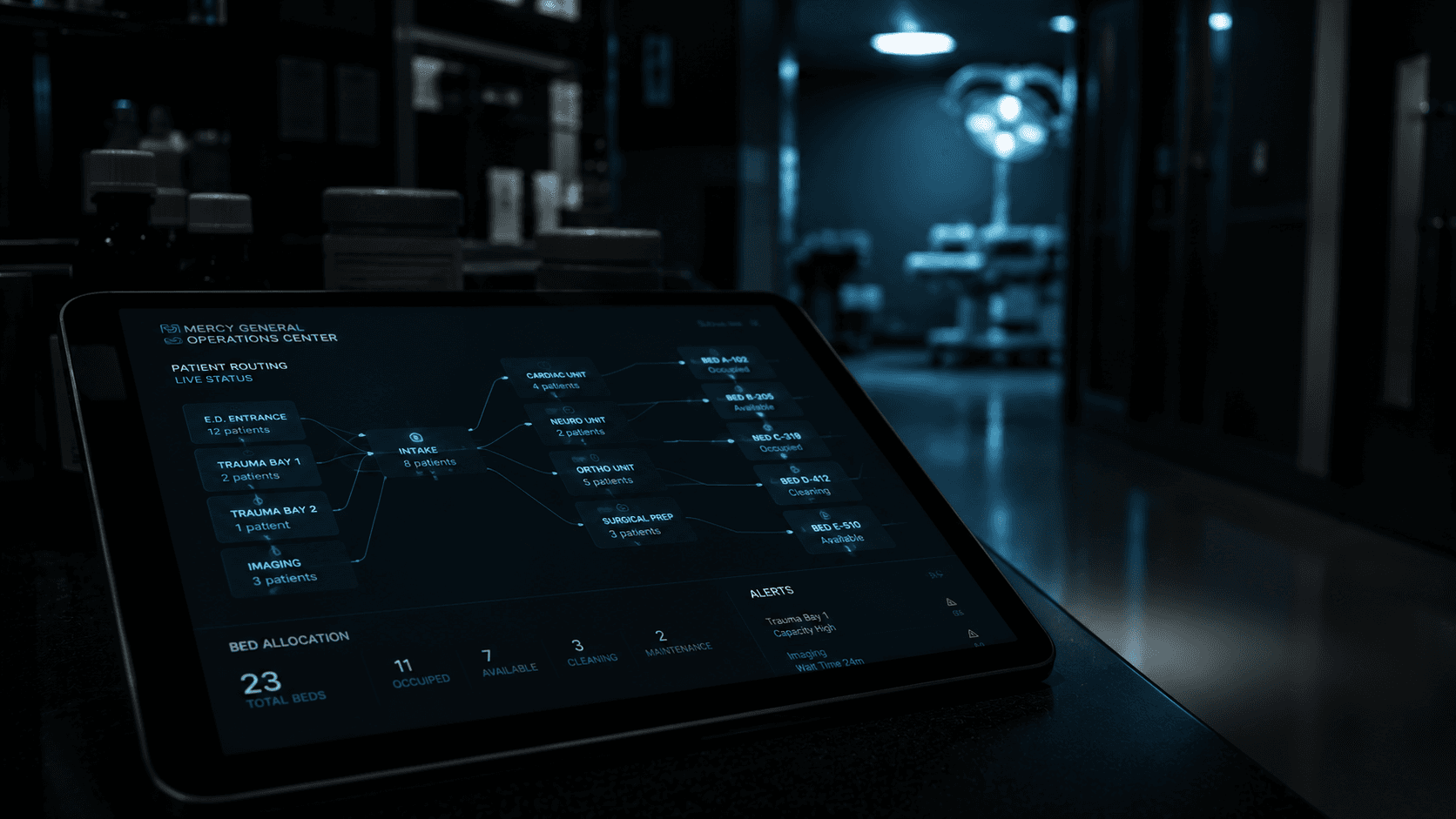
A tech monitoring screen showing connecting nodes with a hospital ICU at the background.

INDUSTRY

HEALTHCARE

MODELS

GPT-4o + CLAUDE 3.5 SONNET + LLAMA 3 LOCAL

TIMELINE

91 DAYS

STATUS

OPERATIONAL — PHASE II: ICU ROUTING

38%

REDUCTION IN ED BOARDING TIME

A 620-bed urban academic medical centre was losing $4.1M annually to emergency department boarding — the clinical and operational failure state where admitted patients remain in ED beds awaiting inpatient placement. A real-time clinical NLP pipeline processing incoming triage notes and EHR signals reduced mean boarding time from 6.8 hours to 4.2 hours and recovered 3,100 inpatient bed-days in the first operational year.

The Baseline Inefficiency

A 620-bed urban academic medical centre operated an emergency department averaging 310 daily visits with a 41% admission rate. Bed placement decisions — matching admitted patients to available inpatient beds across 14 units — were coordinated manually by a bed management team of 6 coordinators working from a static whiteboard system updated every 30 minutes. The mean time from admission decision to physical bed assignment was 6.8 hours. Patients awaiting placement occupied ED treatment bays during this period — a state clinically defined as boarding. The institution's own internal audit quantified boarding at 3,100 wasted inpatient bed-days annually, with a revenue impact of $4.1M based on an average daily room rate of $1,323. Secondary effects included 14% ED diversion rate, meaning ambulances were being redirected to competing facilities during peak boarding periods — a compounding revenue and reputational loss. Nursing overtime attributable to boarding coordination ran at $340K annually.

The Architectural Solution

The core constraint was data sensitivity: all PHI processing required on-premise inference with zero data egress to external APIs. The architecture used a hybrid model routing strategy. A locally-hosted Llama 3 instance (8B, quantised to 4-bit via llama.cpp on dedicated GPU nodes) handled initial triage note parsing and ICD-10 preliminary coding — tasks requiring high throughput at low latency without PHI exposure risk. Claude 3.5 Sonnet ran within the hospital's Azure Government private endpoint for higher-complexity clinical reasoning tasks: acuity trajectory prediction, isolation requirement flagging, and anticipated length-of-stay estimation. GPT-4o handled structured EHR data synthesis, pulling from the Epic FHIR API to combine lab values, imaging orders, and prior admission history into a unified patient acuity vector. The three-model output was aggregated by an orchestration layer that produced a ranked bed placement recommendation list, refreshed every 4 minutes, surfaced to bed coordinators via a custom dashboard replacing the whiteboard system. LangSmith provided inference audit trails required for clinical governance sign-off. Total P99 inference latency from triage note ingestion to placement recommendation: 22 seconds.

The Fiscal Outcome

Mean boarding time fell from 6.8 hours to 4.2 hours — a 38% reduction — measured across the first 90 days of full operation. Wasted inpatient bed-days recovered in year one: 3,100, representing $4.1M in recovered revenue capacity. ED diversion rate fell from 14% to 6%. Nursing overtime attributable to bed coordination decreased by $218K in the first year. The system processed 113,000 triage events in its first operational year with zero PHI breach events. Clinical governance sign-off for Phase II — extending the routing logic to ICU step-down and surgical bed allocation — was obtained at month 8.

Quantifiable Outcomes

BOARDING TIME

38%

Mean ED boarding reduced from 6.8 hours to 4.2 hours.

BOARDING TIME

38%

Mean ED boarding reduced from 6.8 hours to 4.2 hours.

REVENUE RECOVERED

$4.1M

Annual inpatient bed-day capacity restored across 3,100 lost days.

REVENUE RECOVERED

$4.1M

Annual inpatient bed-day capacity restored across 3,100 lost days.

Archive Navigation

CASE_081

$2.3M ANNUAL OPEX RECOVERED

Automated Multi-Ledger Reconciliation via LLM-Augmented Transaction Classification

A Tier-2 payments processor was haemorrhaging 14,000 analyst-hours annually to manual reconciliation across 6 fragmented ledger systems. A fine-tuned classification pipeline reduced exception rates by 94% and eliminated the reconciliation backlog within 60 days of deployment.

INDUSTRY

FINTECH

TIMELINE

78 DAYS

MODELS

GPT-4o FINE-TUNED + CLAUDE 3.5 SONNET

STATUS

OPERATIONAL — PHASE II SCALING

CASE_081

$2.3M ANNUAL OPEX RECOVERED

Automated Multi-Ledger Reconciliation via LLM-Augmented Transaction Classification

A Tier-2 payments processor was haemorrhaging 14,000 analyst-hours annually to manual reconciliation across 6 fragmented ledger systems. A fine-tuned classification pipeline reduced exception rates by 94% and eliminated the reconciliation backlog within 60 days of deployment.

INDUSTRY

FINTECH

TIMELINE

78 DAYS

MODELS

GPT-4o FINE-TUNED + CLAUDE 3.5 SONNET

STATUS

OPERATIONAL — PHASE II SCALING

CASE_081

$2.3M ANNUAL OPEX RECOVERED

Automated Multi-Ledger Reconciliation via LLM-Augmented Transaction Classification

A Tier-2 payments processor was haemorrhaging 14,000 analyst-hours annually to manual reconciliation across 6 fragmented ledger systems. A fine-tuned classification pipeline reduced exception rates by 94% and eliminated the reconciliation backlog within 60 days of deployment.

INDUSTRY

FINTECH

TIMELINE

78 DAYS

MODELS

GPT-4o FINE-TUNED + CLAUDE 3.5 SONNET

STATUS

OPERATIONAL — PHASE II SCALING

CASE_114

94% REDUCTION IN DISCOVERY HOURS

Large-Scale Semantic Discovery Indexing for Litigation Document Intelligence

A top-20 Am Law firm processing 2.3M documents per major litigation matter was spending an average of $1.8M per case in associate review hours prior to attorney eyes-on analysis. A semantic indexing and privilege classification pipeline reduced first-pass review time from 11 weeks to 4 days while maintaining a 99.2% recall rate on privileged document detection.

INDUSTRY

LEGAL

TIMELINE

64 DAYS

MODELS

CLAUDE 3.5 SONNET + TEXT-EMBEDDING-3-LARGE

STATUS

OPERATIONAL — 3 ACTIVE MATTERS

CASE_114

94% REDUCTION IN DISCOVERY HOURS

Large-Scale Semantic Discovery Indexing for Litigation Document Intelligence

A top-20 Am Law firm processing 2.3M documents per major litigation matter was spending an average of $1.8M per case in associate review hours prior to attorney eyes-on analysis. A semantic indexing and privilege classification pipeline reduced first-pass review time from 11 weeks to 4 days while maintaining a 99.2% recall rate on privileged document detection.

INDUSTRY

LEGAL

TIMELINE

64 DAYS

MODELS

CLAUDE 3.5 SONNET + TEXT-EMBEDDING-3-LARGE

STATUS

OPERATIONAL — 3 ACTIVE MATTERS

CASE_114

94% REDUCTION IN DISCOVERY HOURS

Large-Scale Semantic Discovery Indexing for Litigation Document Intelligence

A top-20 Am Law firm processing 2.3M documents per major litigation matter was spending an average of $1.8M per case in associate review hours prior to attorney eyes-on analysis. A semantic indexing and privilege classification pipeline reduced first-pass review time from 11 weeks to 4 days while maintaining a 99.2% recall rate on privileged document detection.

INDUSTRY

LEGAL

TIMELINE

64 DAYS

MODELS

CLAUDE 3.5 SONNET + TEXT-EMBEDDING-3-LARGE

STATUS

OPERATIONAL — 3 ACTIVE MATTERS

INITIATE MANDATE.

ESTABLISH SECURE COMMUNICATION PROTOCOL WITH COGNITION STRATEGY GROUP.

CLEARANCE & SLA PROTOCOLS

CONFIDENTIALITY

Default-Deny NDA Enforced

RESPONSE SLA

T+12 Hours (Principal Only)

DATA ROUTING

E2E Encrypted Transmission

SYSTEM READY // SECURE CONNECTION

ACQUIRE — $149

Create a free website with Framer, the website builder loved by startups, designers and agencies.